How did a small town founded on the banks of the Tiber become the master of the Mediterranean world? With much older and more powerful city-states, alliances, and kingdoms around, how did this one city, Rome, manage to stand out among them all? Was it solely because of their military skills? No, they often faced defeats. So, were they exceptionally brave and fearless? It is said that legionaries feared their own commanders more than the enemy, but in the end, they were human and terrified of death. Did they use much more advanced weapons and armor? They may have had such an advantage against some primitive tribes, but they lacked such superiority against their major enemies. For instance, they adopted their famous sword, the gladius, after seeing it in Spain. Were their commanders tactical geniuses? Some certainly were, but most of the time, their armies were led by ordinary politicians who fought with conventional tactics.
While all of these factors played a role to varying degrees in Rome’s rise, the primary reason was far more modest: their large population. Rome could field legion after legion and, after devastating defeats, quickly raise new armies to continue the fight. This seemingly endless supply of manpower was Rome’s greatest strength.
There could be many reasons why Rome’s population grew much larger than the cities around it. One of the most important factors was Rome’s relatively generous approach to citizenship, in contrast to other city-states. While Athens wouldn’t even grant citizenship to Aristotle, Rome offered partial citizenship even to freed slaves and full citizenship to their children. According to legend, after Rome was founded by Romulus and his warriors, the city became a haven for outlaws, criminals, fugitives, and similar people to encourage its growth. When Romulus sent envoys to neighboring cities to find wives for this band of rough men, the response was, “Make Rome a haven for women as well, and then you’ll find worthy wives.” Romans, furious at the insult, organized a grand festival in Neptune’s honor and kidnapped the daughters and wives of those who had insulted them, who had come to attend the festival with their families. The efforts to grow Rome’s population continued under later kings and consuls, with the inhabitants of conquered cities being forcibly relocated to Rome and made Roman citizens. While these early accounts may be purely mythical, they reflect the liberal mindset of the later historians who wrote them down.
In addition to these policies, Rome’s location was also highly conducive to population growth. In ancient times, finding food was always a struggle. After a poor harvest, during the cold and long winter nights, as Hesiod said, there was little to do other than “rubing a swollen foot with a skinny hand.” Settlements in inland areas could only import wheat, barley, and their derivatives from nearby towns due to high logistical costs, and the same famine likely affected those neighbors as well. Port cities on the other hand could bring in grain from more distant areas, compensating for the poor harvests from their salty, and thus low-yield, coastal lands. Rome, located 25 kilometers inland, had access to fertile agricultural land, while also benefiting from trade and transport via the Tiber River which the Romans called pater, meaning “father,” allowing it to function like a coastal city in terms of imports and exports and provided relative protection against times of famine.
As a result of geographical advantages and beneficial policies, Rome’s population grew relentlessly. What was once a small, ordinary Latin city became so powerful that it could field armies capable of challenging the entire Latin League on its own. Rome then succeeded in fighting and prevailing over the Etruscans to the north, the Samnites to the south, and the Sabines and Apennine peoples to the east. Although it suffered defeats in these wars, it managed to replace fallen soldiers with new recruits each time. Meanwhile, its enemies were often forced to surrender after a major defeat.
In 218 BC, during a period when Rome had conquered Italy and incorporated overseas colonies such as Sicily, Sardinia, and Corsica, the Carthaginian general Hannibal invaded Italy with his army. At this time, according to census reports, there were 300,000 Roman men. Hannibal and the Romans faced each other in three major battles over the course of two years, each resulting in a severe defeat for Rome. Additionally, two legions were ambushed and destroyed by the Gauls. Between 218 and 215 BC, Rome had fielded 108,000 citizens, of whom 50,000 had been killed. Sixth of the male population! Hannibal, who had killed every Roman he captured up to the Battle of Cannae, believed that Rome would surrender after losing so many soldiers in such a short time and that his allies would abandon him. He sent an envoy to Rome, offering to release thousands of captured legionaries for a price. However, Rome’s response was grim: Instead of surrendering, they too should die on the battlefield like their comrades. Consequently, despite lowering the age for military service, enlisting freed slaves, and calling up older men, Rome managed to field new legions and draw Hannibal into a war of attrition he could not win.
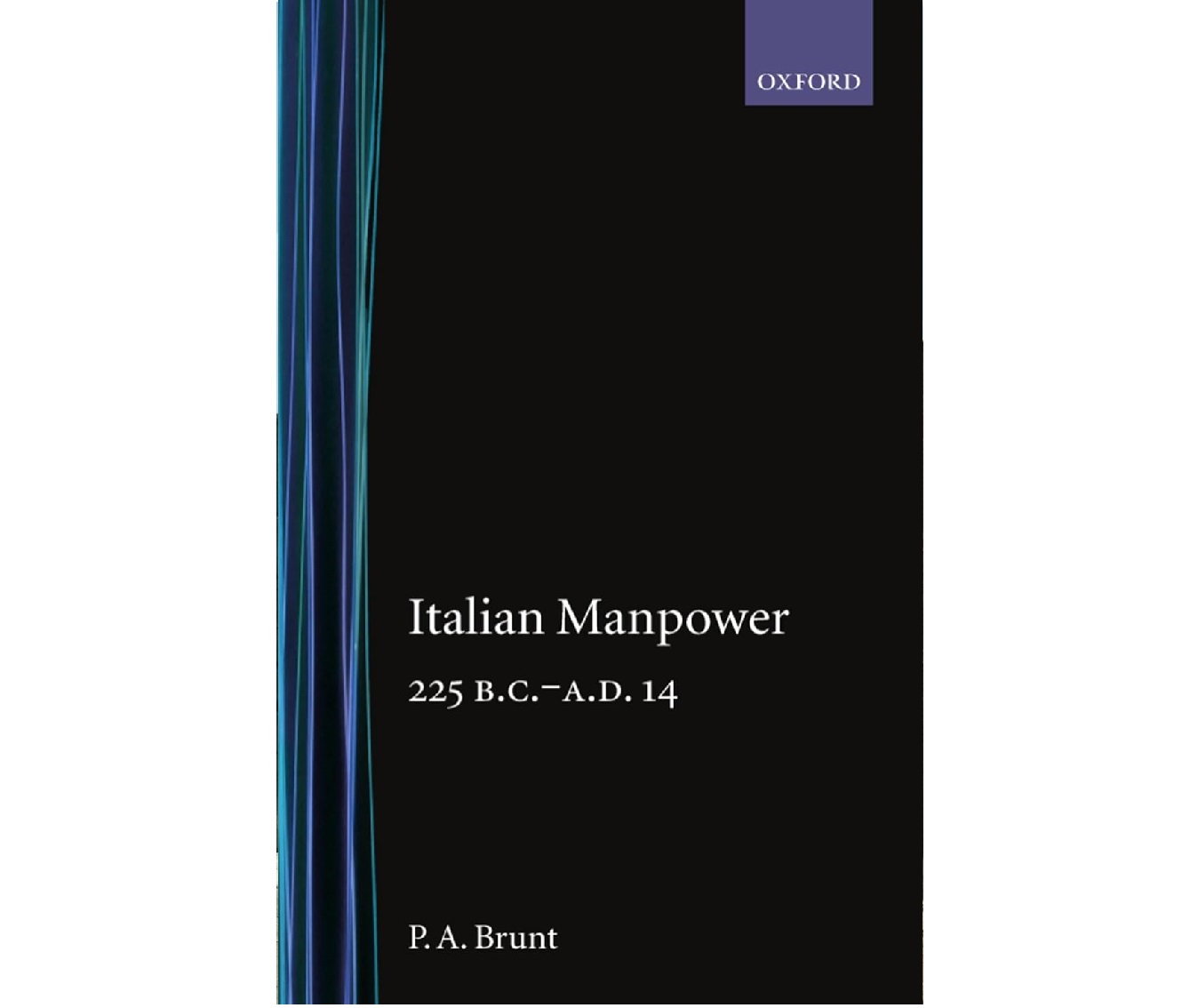
One of the most prominent ancient historians of his time (1970s), Oxford Camden Professor P. A. Brunt, in his highly influential book Italian Manpower, examines in great detail Rome’s population and the military force it could field, from just before the Hannibalic War, in 225 BC to AD 14. In his own words, “It was with the aim of linking the history of the Italian population with the consequences of war that I undertook to write this.” Following in the footsteps of another legendary German historian, K. J. Beloch, who conducted a similar population study, Brunt significantly broadened the scope and built upon it to produce a remarkably comprehensive work.
The research consists of four sections. In the first section, census reports are discussed to estimate the population of Italy. The second section examines the population outside Italy, that is, in the provinces. The third section focuses on special circumstances directly affecting the population, such as the Hannibalic Wars. The fourth section provides a detailed analysis of how Rome utilized this population; the number and status of the legions. Additionally, there is an appendix section, so extensive and detailed that it could almost be considered a fifth section, consisting of 29 topics. These cover special subjects that are too long to be given in footnotes and too tangential to be included in the main body of the text.
In the first section, the census figures learned from various literary documents are examined. The biggest debate revolves around who was counted in these censuses. It is certain that women and slaves were not counted, but what about the capite censi (landless Romans), the elderly, cives sine suffragio (citizens without vote), and freedmen? Given that the capite censi might as many as the assidui (propertied class), determining this is crucial. Although the evidence he presents is indirect, Brunt argues that the aforementioned individuals were included in the census.
Brunt holds the view that census figures are highly unreliable. He suggests that around 10% of citizens evaded the census for various reasons, though he has no solid evidence to support this claim. The 10% figure is an arbitrary number that amounts to little more than a blind guess. He uses this 10% shortfall to explain the census anomaly observed in 131 BC: in 131, the population was 318,000, but in 125, it suddenly jumped to 394,000. This leap cannot be explained by natural growth. Brunt’s solution is as follows: the 10% who had evaded the census joined it in 125 to benefit from the Gracchi brothers’ distribution of public lands.
A similar problem is found in the censuses of 86 and 70 BC. The 115 census shows a population of 394,000, while in 86, it was 463,000. Sixteen years later, in 70, it suddenly jumped to 900,000. Beloch suspects that the text recording the census figures for 86 BC is corrupt, suggesting that the letter D (500) was accidentally omitted by a copyist, and that the original text actually read 963,000. In other words, the population decreased from 963,000 to 900,000 over 16 years. Considering the bloody wars that took place between 86 and 70. Brunt, who does not accept this explanation, claims that the censors deliberately underreported the numbers to weaken Cinna’s power.
The same problem arises again with Augustus’ census of 28 BC. While the census of 70 BC shows a population of 900,000, the census of 28 BC records 4,063,000. Although 42 years had passed, this is still an incredible increase. Brunt suggests that Augustus counted not only citizens but also women and children, and that this is the reason for the increase. However, Res Gestae uses the phrase civium Romanorum capita censa sunt (the heads of Roman citizens were counted). It is not clear whether cives (citizen) could be used for Roman women and children.
In the second section, Brunt attempts to determine the number of citizens in the provinces. He uses legion and recruitment data to make this estimate. He convincingly demonstrates that before Caesar, the citizen population in the provinces was not very large. His evidence is the small number of soldiers that could be recruited from the provinces during the civil wars. However, he explains that after Caesar, numerous citizenships were granted, and colonies were established. According to his calculations, while there were 150,000 citizens living in the provinces in 49 BC, this number increased to 375,000 by 28 BC.
The third section is dedicated to specific population studies. In this part, we read about the hardships endured by Italy, especially the southern regions. Southern Italy, first ravaged during the Hannibalic Wars, was further punished by the Romans after Hannibal’s defeat. Its lands were confiscated and transformed into latifundia (large estates) managed by slaves. Afterward came the Social War, followed by the Sulla-Marius conflict, the revolt of Lepidus, and the Spartacus uprising. As a result, the population of southern Italy never returned to its pre-Roman domination levels.
The fourth section begins with legionary service and military recruitment in Rome. It discusses the distinction between the dilectus (conscription) and voluntary enlistment. Brunt demonstrates that the creation of legions was not entirely based on voluntary enlistment after Marius; dilectus continued throughout. As is well known, becoming a legionary initially required a certain amount of wealth. The 1st, 2nd, and 3rd wealth classes served as infantry, while the 4th and 5th classes took on support roles like light infantry, javelin throwers, and slingers. Proletarians or capite censi who did not even possess enough wealth to qualify for the 5th class were not initially recruited for legions. Brunt argues that the wealth threshold for the 5th class was gradually lowered, allowing more ex-proletarians to be enlisted, and that Marius eventually abolished this requirement altogether. He argues that, Marius merely legalized what was already in practice and therefore did not implement as significant a reform as previously thought. He says by Marius’ time, equipment was provided by the state, so soldiers no longer needed to be wealthy anyway. However, Brunt approaches the issue solely from the standpoint of wealth and equipment, neglecting the cultural differences and prejudices between social classes. Romans traditionally refrained from recruiting proletarians not just because they couldn’t afford their own equipment, but also because they were thought to lack ties to land and having nothing to lose but their lives, were believed to be more likely to flee, endangering all the legion. In contrast, a farmer from the upper classes was considered to have more at stake, including their lands and all the wealth, and would therefore fight more fiercely. Given this prejudice, Marius’ reform represents a major societal shift, as it challenged and changed deeply ingrained social norms.
Today, the book’s core demographic thesis is categorized as the low-count model and is largely rejected by modern scholarship. Critics argue that such low population figures would result in a non-farming population ratio completely unsustainable within a traditional agrarian economy. Consequently, contemporary demographic debates now center almost exclusively around high-count and mid-count estimates. Nevertheless, Brunt’s work remains a cornerstone text in Roman demographyand and can be read to understand the foundational arguments that shaped modern theories in the field.
Review of Brunt, P. A. Italian Manpower.
Leave a Reply