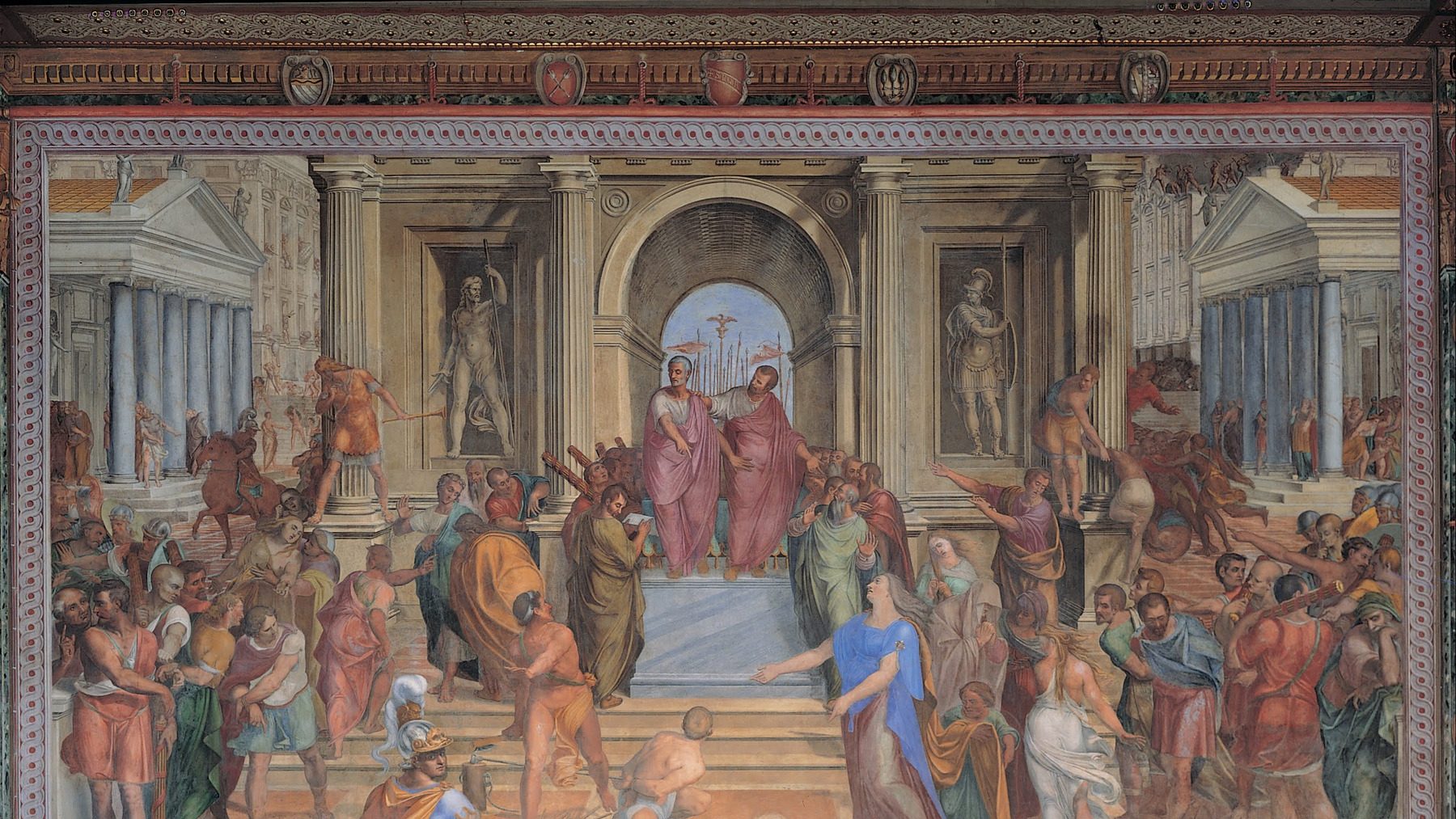

The education of a classicist proceeds through the Roman elite. Through the texts written by this elite, the Latin language is learned alongside their worldview, culture, behavioral patterns, and political activities. Toner points out that what we learn about Ancient Rome actually pertains to a very small privileged class. In his book, he aims to focus on the other side of Rome, namely, the lives of what he calls the “non-elite.” This is a challenging task, considering that almost all surviving Latin literature was written by the elite. The author confines his research to the period between the 1st century BC and the 5th century AD, organizing his material into five main categories for examination: problem-solving methods of the non-elite, mental health, entertainment, their perceptions of their surroundings, and uprisings.
As the author indicates, there is very limited material about the lives of the non-elite. To provide a consistent narrative, Toner chooses to focus on a very long time period of 600 years. It is known that during different periods of Roman history, such as the Republican, Augustan, and Constantinian eras, the social structure in Rome changed significantly, so popular culture may have also differed considerably. Yet in this study, there is a tendency to generalize information derived from the anecdotes of ancient writers to all Romans across different historical periods. Similar to the timeline, differences within non-elite groups (non-elite citizens, freedmen, and slaves) are also disregarded. For instance, the economic situations of six different non-elite families living in a six-story Roman apartment building must have varied significantly. There could be quite a different culture between the poorest families, who shared a tiny apartment on the top floor without bathrooms or kitchens, and the relatively wealthy but non-elite families living on the ground floor. Yet such differences are not taken into account, and the available material has been generalized under the broad category of the non-elite.
Toner could have overcome this issue of generalization by focusing deeply on a specific aspect of non-elite culture, such as problem-solving, instead of writing a general book despite the limited material available. For example, the section he wrote about the visual perception of the people, which is largely based on literary sources without focusing on graffiti and other visual materials, remains quite incomplete. One might ask: why write a section about visual perception without actually utilizing visual evidence?
Although Toner gathers a wide variety of material from many different authors, he sometimes accepts these sources without extensive critical scrutiny. The anecdotes of satirical writers like Petronius and Lucian, as well as historians known for their anecdotal tendencies like Ammianus Marcellinus and Suetonius, are frequently presented as direct glimpses into the lives of the non-elite. While striving to evade the traditional elite lens of figures like Cicero, Toner inadvertently relies on the exaggerated perspectives of satirists. Consequently, this methodological choice sometimes gives the impression that the work is more of a curated sourcebook than a fully synthesized monograph.
Despite the methodological issues, the first two chapters are genuinely enjoyable. The inclusion of lesser-known literary sources such as the Sortes Astrampsychi is both informative and engaging. However, the aforementioned problems become much more evident in the subsequent three chapters. Ultimately, the book represents a well-intentioned attempt to tackle a notoriously difficult subject, even if its execution remains somewhat uneven.
Review of Toner, J. Popular Culture in Ancient Rome.
Leave a Reply